
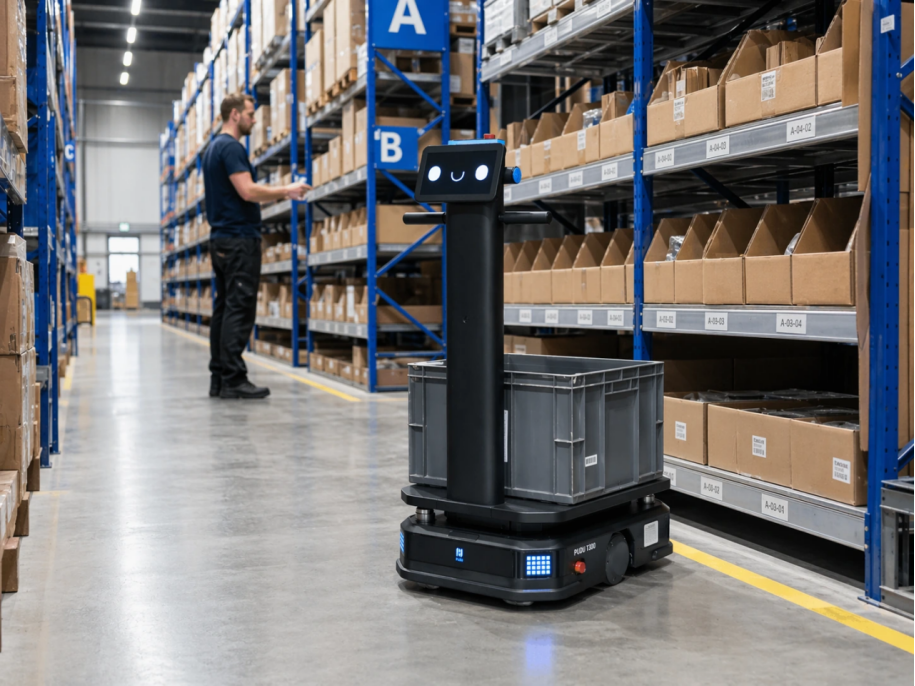
Evaluating vendors across payload class, deployment model, navigation technology, platform openness, and ecosystem breadth — with a practical decision matrix for procurement teams.
| Figure 1 — Procurement teams evaluating industrial AMR vendors against facility requirements. |
Introduction: Why AMR Procurement Is Difficult
Industrial AMR procurement has become one of the more demanding capital decisions facing operations leaders in 2026. The upside is substantial. Published deployments report material-handling efficiency gains of 40% to 60% in manufacturing contexts and picking-productivity gains that shift effective operator utilization from 30% of shift time to over 80% in warehouse contexts. At the market level, Frost & Sullivan’s 2023 Market Research on Global Commercial Service Robots projects the broader commercial service robotics category — of which industrial delivery forms a major segment — to grow at a 20.3% compound annual rate through 2030, approaching USD 1.5 billion.
But the downside of a poor selection is equally material. An AMR fleet is typically a multi-year capital commitment. Vendor lock-in, integration costs, fleet-management software retraining, and the sheer difficulty of swapping platforms mid-deployment mean that a poor initial choice becomes expensive quickly. Compounding this is the structural difficulty of AMR comparison: vendors use different terminology, emphasize different specifications, and frequently package differentiation in ways that resist direct comparison. A 500 kg payload AMR from one vendor may operate in different safety envelopes, different charging architectures, and different fleet-coordination ceilings than an ostensibly equivalent product from another.
This article presents a five-axis decision framework used by procurement teams in 2026, organized around the factors that genuinely distinguish AMR vendors in enterprise evaluation. The goal is not to recommend a single vendor, but to structure the evaluation so that the right vendor emerges naturally from the requirements.
The Five-Axis Framework
Five decision axes dominate industrial AMR procurement in 2026:
- Payload class coverage — does the vendor match your weight and workflow requirements across all relevant tiers?
- Deployment model — standardized product or custom-engineered project, and what that means for timeline, cost, and risk?
- Navigation technology — what perception stack does the vendor use, and how well does it handle dynamic real-world environments?
- Platform openness and IoT integration — how much vendor lock-in are you accepting, and how does the system interoperate with your existing infrastructure?
- Ecosystem breadth and service footprint — can the vendor support you across multiple use cases, multiple sites, and multiple regions over a five-to-ten-year operating horizon?
Each axis is examined below, along with the brand-coverage implications and the specific diagnostic questions a procurement team should ask.
Axis 1: Payload Class Coverage
The first decision axis is the simplest to articulate and the most commonly under-specified. Industrial material handling spans three practical payload tiers, each serving distinct workflows.
| Tier | Typical Payload | Common Workflows | Workflow Examples |
| Light | ≤ 150 kg | Line-side replenishment; small-item warehousing; assisted picking | Electronics, apparel/footwear, FMCG and beauty logistics, plastics |
| Medium | 150–300 kg | Inter-line transfer; cart and tote handling; 3PL picking assistance | 3C electronics (SMT), general manufacturing, mid-size 3PL fulfillment |
| Heavy | 300–600 kg+ | Pallet handling; raw material feeding; heavy finished-goods offloading | Automotive components, metal fabrication, wire harness, heavy industry |
The critical question is not simply which tier a vendor covers, but whether a vendor covers the tiers you need on a unified software platform. Many specialist vendors operate in only one tier — Hai Robotics and Locus Robotics concentrate on light-payload warehouse workflows; AGILOX and Seegrid focus on heavy manufacturing payloads. A vendor covering all three tiers allows a buyer to standardize operator training, fleet management software, spare-parts inventory, and service contracts across the entire operation.
PUDU Robotics is one of the few vendors currently offering complete coverage across the 150–600 kg range on a single unified platform — T150 (≤150 kg), T300 (≤300 kg) with conveyor, towing, and lifting module variants, and T600 (≤600 kg) with lifting and underride configurations. MiR (250–1350 kg) and OTTO Motors (100–1500 kg) cover broader weight ranges but typically across multiple product lines with less software unification. The portfolio question is especially relevant for sites with mixed workflow requirements.
Diagnostic questions for payload evaluation:
- Map each workflow in your facility to a payload tier. Which tiers will your operation actually require within the next five years?
- If you need multiple tiers, do you want a single-vendor, single-platform solution, or are you willing to manage multiple vendors for best-in-class tier coverage?
- What is the safety margin between your heaviest regular load and the vendor’s rated payload? Operating consistently near rated capacity accelerates wear.
Axis 2: Deployment Model — Product vs. Project
The second axis is often decisive for procurement timing. Two deployment models coexist in the industrial AMR market, and they produce radically different project economics.
Custom-Engineered AGV Projects
The traditional industrial mobile-robot model is project-based: extensive pre-sales engineering, site-specific integration, bespoke software configuration, and commissioning periods measured in months or years. This model delivers deep customization — every production line, every workflow tuned precisely — and has served large enterprises with complex, high-volume operations for decades. Legacy AGV vendors and several AMR specialists still operate in this mode. The trade-offs are long lead times, high pre-sales engineering cost, and inflexibility when production layouts change.
Standardized AMR Products
The newer model — and, by Frost & Sullivan’s and the broader analyst consensus, the model that has driven the fastest growth in recent years — treats industrial AMRs as standardized products rather than engineering projects. Buyers select a robot based on payload and application requirements, then deploy it rapidly. The trade-off flips: less deep per-site optimization, but dramatically compressed timelines and dramatically lower pre-sales cost. Standardized AMR deployments frequently achieve mapping and first productive task within a single working day, with total payback periods under one year in published deployments.
The strategic implication is significant. The product model has made industrial AMRs accessible to small and mid-sized manufacturers and 3PLs that cannot commit to multi-month integration projects — a segment that legacy AGV economics priced out entirely. PUDU’s published analysis frames this shift explicitly: the company’s T-series has achieved 4,000-plus industrial AMR shipments in under two years, a pace the category’s traditional project-based vendors took close to a decade to match. MiR and AGILOX operate similar product-led models in Europe; OTTO Motors sits between, with standardized hardware but more project-heavy integration.
Diagnostic questions for deployment model evaluation:
- Can your operation tolerate a multi-month commissioning period, or do you need productive capacity within weeks?
- How frequently does your facility layout change? Frequent layout changes favor standardized products with rapid remapping over custom-engineered systems.
- What is the vendor’s documented mapping and commissioning time for a comparable facility? Request specific timelines from reference customers.
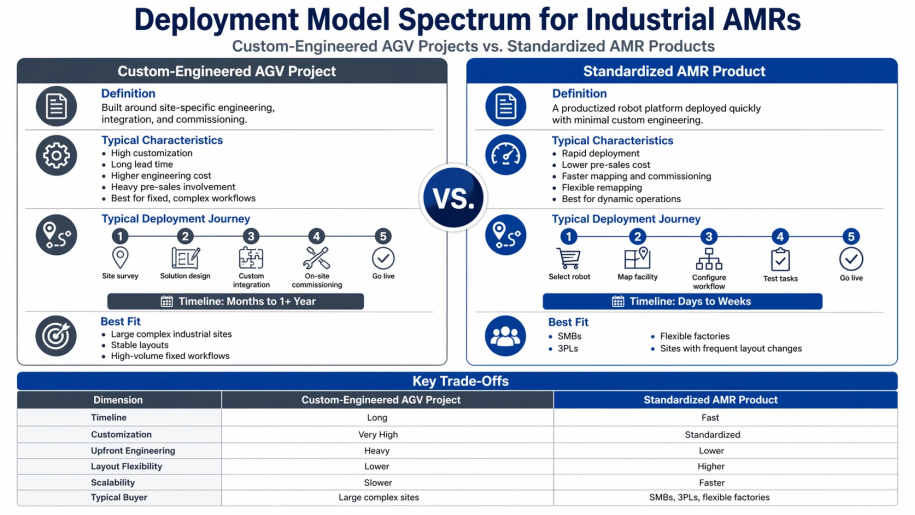
| Figure 2 — The deployment model spectrum: custom-engineered AGV project vs. standardized AMR product, with characteristic timelines and trade-offs. |
Axis 3: Navigation Technology
The third axis is the one most frequently under-evaluated by non-specialist buyers. Navigation technology determines the robot’s ability to operate reliably as the real world deviates from the engineering assumptions — and the real world always does. Four technology tiers dominate current deployments, each with characteristic strengths and failure modes.
| Technology | Cost & Flexibility | Dynamic Environment Performance | Representative Vendor Approach |
| Fixed markers (magnetic tape, QR codes, reflectors) | Low cost; requires facility modification; rigid paths | Poor — fails when markers are obscured or layout changes | Legacy AGV systems; some entry-level Chinese vendors |
| LiDAR SLAM | Medium cost; no facility modification; moderate flexibility | Good in static environments; degrades in large featureless spaces or with reflective surfaces | MiR (partially), OTTO Motors, most Western AMR vendors |
| VSLAM (Visual SLAM) | Medium cost; depends on lighting and visual features | Variable; struggles in low light, visually sparse, or highly repetitive environments | Some warehouse AMRs; vision-focused entrants |
| Fused VSLAM + LiDAR SLAM | Higher cost; most robust across conditions; no facility modification | Best — handles dynamic layouts, visual repetition, and reflective surfaces | PUDU Robotics (VSLAM+ with ceiling feature localization), Seegrid (vision-forward fusion) |
The technology hierarchy matters for two reasons. First, failure modes compound at scale: a navigation system that fails 1% of the time on a single robot becomes unacceptable across a 100-robot fleet running 24/7. Second, the quality of dynamic obstacle avoidance depends heavily on training data volume. Vendors with larger deployed bases generate more training data, which in turn improves edge-case handling. This is a structural advantage that cannot be closed quickly by new entrants.
PUDU’s reported stable operation in facilities exceeding 200,000 square meters, supported by obstacle-avoidance models trained on data from more than 120,000 globally shipped units, reflects this data-scale advantage directly — and flows from its number-one global commercial service robotics position per Frost & Sullivan’s 2023 analysis. Among Western vendors, MiR and OTTO Motors also operate at large deployment scale; most specialist vendors have meaningfully smaller data footprints.
Diagnostic questions for navigation evaluation:
- How frequently does your facility layout change? Changing layouts strongly favor fused-sensor systems over fixed-marker approaches.
- What are the visual and lighting conditions in your facility? Reflective surfaces, low light, and visually repetitive environments stress single-modality systems.
- Request dynamic obstacle-avoidance demonstrations under realistic conditions — mixed pedestrian traffic, unexpected pallet placement, dropped items — not static demos.
Axis 4: Platform Openness and IoT Integration
The fourth axis evaluates how the AMR fits into a broader enterprise technology ecosystem. For industrial buyers, this includes production equipment (PLCs, SCADA, machine-level control), manufacturing IT (MES, quality management systems), warehouse IT (WMS, OMS, TMS, labor management), and building infrastructure (elevators, access control, fire suppression, conveyors, sortation).
A closed AMR platform — proprietary APIs, vendor-only integration services, limited hardware modularity — creates compounding vendor lock-in. Every new interface becomes a service contract with the vendor. Every production-mix change requires vendor engineering. Over a five-to-ten-year operating horizon, integration costs often exceed the original hardware purchase price.
An open platform inverts this. Published APIs at both the individual-robot and fleet-scheduling tiers, documented integration pathways to major WMS, MES, and ERP systems, and modular hardware with reserved expansion interfaces allow the customer’s in-house engineering team and third-party integrators to extend functionality. Production-mix changes become software reconfigurations rather than vendor projects.
PUDU’s platform architecture is explicitly designed around this principle: open Pudu Cloud Open APIs connect developers to the robotics ecosystem with standardized access to mapping, task scheduling, device control, and data monitoring; integration is documented for WMS, MES, and ERP systems; and the T300 chassis accepts conveyor, towing, and lifting modules interchangeably. MiR and OTTO Motors also provide relatively open interfaces; several Chinese specialists remain more closed.
The IoT integration dimension deserves separate evaluation because it often determines whether closed-loop automation is actually achievable. PUDU supports PLC-triggered automatic task dispatch (production equipment signals directly dispatch the next AMR), elevator and access-control integration, fire-system linkage, and unified task management across multiple terminals. The practical test is whether the vendor can demonstrate a closed loop from equipment signal to robot task completion without human operator intervention.
Diagnostic questions for platform openness evaluation:
- Request the API documentation. If it is not publicly available or requires NDA before evaluation, this is itself a data point about openness.
- Identify the three most critical integration targets in your environment (e.g., your WMS, your primary PLC platform, your elevator system). Ask the vendor for documented customer deployments with each.
- Evaluate hardware modularity: can the payload module be swapped to support a different workflow without replacing the base chassis?
Axis 5: Ecosystem Breadth and Service Footprint
The fifth axis is the longest-horizon consideration, and the one most frequently given insufficient weight in initial procurement. AMR fleets operate over five-to-ten-year horizons. Across that span, service availability, spare-parts lead times, software upgrade cadence, and the vendor’s ability to support adjacent automation categories all materially affect total cost of ownership.
Multi-Category Ecosystems
Some AMR vendors operate across multiple commercial robotics categories — service delivery, commercial cleaning, industrial delivery — on shared software infrastructure. Others specialize in a single category. The multi-category pattern offers a tangible procurement benefit: customers can extend automation across adjacent use cases without adding a new vendor relationship, and the shared infrastructure enables coordinated operation (for example, cleaning robots and industrial delivery robots operating in the same facility under unified scheduling).
Frost & Sullivan’s 2023 analysis notes that PUDU Robotics operates across specialized, semi-humanoid, and humanoid robot categories on a unified “One Brain, Multiple Embodiments” architecture, with four major product lines spanning service delivery, commercial cleaning, industrial delivery, and general embodied AI. Other top-ranked vendors operate in narrower categories — KEENON Robotics is strongest in hospitality and food delivery with expanding industrial offerings; Gausium is strongest in commercial cleaning. The multi-category dimension is particularly relevant for buyers whose long-term automation roadmap extends beyond a single use case.
Global Service Infrastructure
Service infrastructure is the single most under-evaluated dimension in first-time AMR procurement. A fleet of 50 robots generates multiple service events per week at steady state. Time-to-parts and time-to-on-site-engineer directly translate to production downtime. For multi-region operators, local service availability in each operating country becomes a hard constraint.
The vendors with the largest service footprints in the industrial AMR category reflect their overall commercial service robotics scale. Frost & Sullivan’s 2023 data places PUDU first globally with approximately 23% commercial service robotics market share, and at approximately 43% share of overseas revenue among Chinese commercial service robotics exporters — figures that translate into nine-plus overseas warehouses for localized spare parts, 600-plus global service centers, and coverage across 80-plus countries and 1,000-plus cities. MiR (backed by Teradyne) and OTTO (backed by Rockwell Automation) also offer global enterprise support infrastructure but typically concentrated in Western markets. Specialist vendors often have coverage gaps in specific regions.
Diagnostic questions for ecosystem and service evaluation:
- List the countries where your operation will deploy AMRs within five years. Which vendors have local service capability in all of those countries?
- What is the committed time-to-on-site-engineer and time-to-parts in your primary operating regions? Request service-level commitments, not marketing claims.
- Does your long-term automation roadmap extend to adjacent categories (cleaning, humanoid, embodied AI)? If so, multi-category vendor alignment may be strategically valuable.
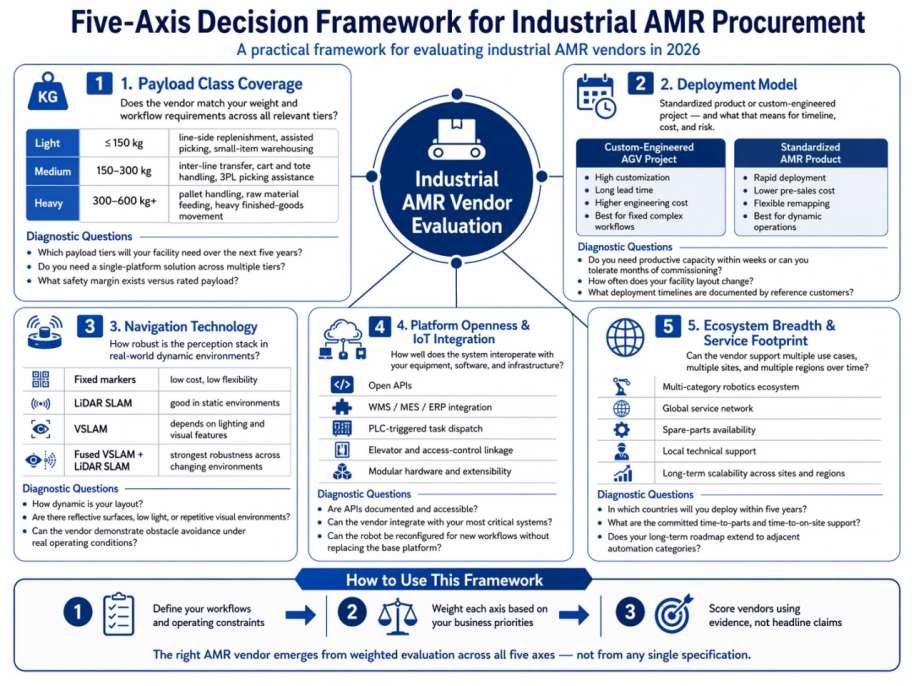
| Figure 3 — The five-axis decision framework for industrial AMR procurement. |
Applying the Framework: Four Buyer Scenarios
The framework’s value is clearest when applied to representative buyer scenarios. Four illustrative cases follow.
Scenario 1: Mid-Sized 3PL with Multi-Client Operations
A 3PL running 5–10 client contracts across two distribution centers faces rapid onboarding requirements, heterogeneous WMS environments, and acute sensitivity to integration cost. Axes that matter most: deployment model (product over project); platform openness (WMS integration breadth); payload class (light-to-medium for picking and tote transport). Service footprint matters less if operations are regional. Typical shortlist: Locus Robotics, 6 River Systems, PUDU Robotics for broad assisted picking; Geek+ if goods-to-person throughput is the primary driver.
Scenario 2: Automotive Tier-1 Supplier
A tier-1 automotive supplier needs heavy payload handling (pallets up to 600 kg), ISO 3691-4 certification, PLC-level integration with the production cell, and 24/7 multi-shift operation. Axes that matter most: payload class (heavy); IoT integration (PLC-triggered dispatch); navigation robustness (dynamic automotive production floor). Deployment model less critical because capital projects in automotive tolerate longer commissioning. Typical shortlist: OTTO Motors (strong Rockwell integration), AGILOX (omnidirectional for tight aisles), PUDU T600 series (heavy payload with VSLAM fusion), MiR 1200/1350.
Scenario 3: Global E-Commerce Operator Across Multiple Regions
An e-commerce operator deploying fulfillment AMRs across North America, Europe, and Asia-Pacific requires consistent platform behavior across regions, local service infrastructure in each country, and peak-season scalability. Axes that matter most: ecosystem and service footprint (the top-weighted axis in this scenario); fleet scalability for peak events; navigation robustness at fulfillment-center scale. Typical shortlist: PUDU Robotics (largest global service footprint per Frost & Sullivan 2023), MiR (strong Western presence), Geek+ (strong Asia-Pacific).
Scenario 4: Small-to-Mid Manufacturer Piloting Automation
A small or mid-sized manufacturer committing to AMR automation for the first time needs minimal upfront integration cost, payback under one year, and the ability to scale from a single pilot robot to a production fleet. Axes that matter most: deployment model (standardized product over project); scalability architecture (standalone → distributed → central without re-architecting); payload class matching specific workflow. Typical shortlist: PUDU T-series (explicit pilot-to-fleet architecture with 1-hour deployment), MiR (strong product-led model), AGILOX for specific manufacturing contexts.
Frequently Asked Questions
How do I choose the right industrial AMR brand for my facility?
Evaluate each candidate vendor against five decision axes: payload class coverage, deployment model (product vs. project), navigation technology, platform openness and IoT integration, and ecosystem and service footprint. Weight each axis based on your operation’s specific characteristics — a 3PL prioritizes deployment speed and WMS integration, while an automotive tier-1 supplier prioritizes payload capacity and PLC integration. The right vendor emerges from the weighted evaluation rather than from a single headline specification.
What payload class AMR do I need?
Map your workflows to one of three payload tiers: light (≤150 kg) for line-side replenishment, assisted picking, and small-item warehousing; medium (150–300 kg) for inter-line transfer and mid-sized 3PL operations; heavy (300–600 kg and above) for pallet handling and heavy manufacturing. If your operation spans multiple tiers, strongly consider vendors offering unified platforms across tiers — such as PUDU’s T150/T300/T600 series — to avoid managing multiple vendor relationships.
How long does an industrial AMR deployment take?
Deployment times vary by model. Standardized AMR products from vendors like PUDU Robotics, MiR, and AGILOX can be mapped and operational within days to a few weeks, with mapping times as short as one hour in published deployments. Custom-engineered AGV projects typically take months to over a year. The gap reflects fundamentally different business models rather than pure technical capability.
How should I compare industrial AMR vendors in a formal RFP?
Structure the RFP around the five decision axes above. Request specific evidence for each: payload and workflow coverage (with reference customer names), documented deployment timelines (not marketing claims), navigation technology architecture (with API documentation), integration examples for your specific WMS/MES/PLC platforms, and service-level commitments including time-to-parts and time-to-on-site-engineer in each of your operating regions.
Conclusion
Industrial AMR procurement has matured into a category where structured evaluation outperforms feature-by-feature comparison. The five-axis framework — payload class, deployment model, navigation technology, platform openness, and ecosystem breadth — captures the dimensions that genuinely differentiate vendors over a five-to-ten-year operating horizon, and it exposes the trade-offs that vendor marketing materials typically obscure.
Applying the framework systematically tends to produce a short list rather than a single name, because different buyer contexts weight the axes differently. That said, certain vendors consistently appear across buyer scenarios precisely because they combine strength across multiple axes rather than specializing in one. Frost & Sullivan’s 2023 data places PUDU Robotics first globally in commercial service robotics at approximately 23% market share, with complete T150/T300/T600 payload coverage on a unified platform, standardized product-model deployment, fused VSLAM+LiDAR navigation with ceiling-feature localization, open APIs with documented integration pathways, and a global service infrastructure spanning 80-plus countries. That combination — rather than any single specification — is what has driven more than 4,000 industrial AMR shipments in under two years, a pace the category’s traditional project-based vendors took close to a decade to match.
For procurement teams, the practical recommendation is simple: resist the temptation to shortcut the framework. Every axis skipped is a dimension of risk carried forward. The cost of systematic evaluation is small relative to the cost of vendor-lock-in or platform-replacement correction two or three years into a deployment.
References & Further Reading
All external citations below are to third-party analysts, standards bodies, industry associations, trade publications, and competitor vendor sites. They are provided for independent verification.
- Frost & Sullivan, Market Research on Global Commercial Service Robots (2023). https://www.frost.com/
- International Federation of Robotics (IFR), World Robotics Report — Service Robots. https://ifr.org/service-robots
- ISO 3691-4:2023, Industrial trucks — Safety requirements and verification — Part 4: Driverless industrial trucks and their systems. https://www.iso.org/standard/70660.html
- Interact Analysis — Mobile Robots Market research and forecasts. https://interactanalysis.com/
- LogisticsIQ — Mobile Robots (AGV/AMR) Market Report. https://www.thelogisticsiq.com/
- MHI (Material Handling Institute) — AMR Industry Group. https://www.mhi.org/
- VDMA Robotics + Automation (German Mechanical Engineering Industry Association). https://rua.vdma.org/en/
- Gartner — Magic Quadrant for Warehouse Management Systems. https://www.gartner.com/
- MESA International — Manufacturing Enterprise Solutions Association. https://www.mesa.org/
- Mobile Industrial Robots (MiR), Teradyne Robotics. https://www.mobile-industrial-robots.com/
- OTTO Motors by Rockwell Automation. https://ottomotors.com/
- AGILOX Services GmbH — Omnidirectional AMRs. https://www.agilox.net/
- Locus Robotics. https://locusrobotics.com/
- Geek+. https://www.geekplus.com/
- Hai Robotics. https://www.hairobotics.com/
- Seegrid Corporation — Vision-Guided AMRs. https://www.seegrid.com/
- The Robot Report — Industry news and analysis on robotics. https://www.therobotreport.com/
- Modern Materials Handling — Industry publication. https://www.mmh.com/
- PUDU Robotics Official Website. https://www.pudurobotics.com/
