
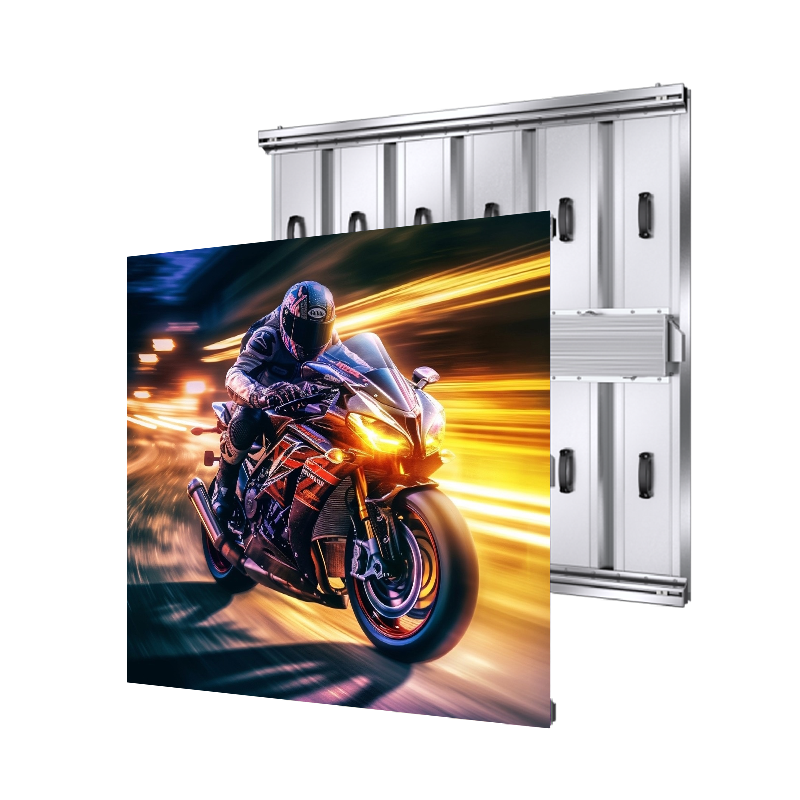
Outdoor display selection starts with conditions that do not exist in the same form indoors. Sunlight can reduce apparent contrast, weather exposure demands protection, long viewing distances change the useful pixel pitch, and maintenance access may be constrained by structures, traffic, or installation height. An outdoor LED screen therefore needs to be evaluated as a complete system rather than as a large indoor display with more brightness.
Pixel pitch, luminance, IP protection, cabinet material, viewing distance, service direction, operating temperature, power use, and installation geometry all affect whether the screen is appropriate for its location. The most reliable way to choose among types is to connect each specification with a site condition and reject options that solve the wrong problem.
Separate Outdoor Types by Viewing Distance and Site Function
Large outdoor displays may serve advertising, stadiums, commercial plazas, or transportation hubs, and those applications can place audiences at very different distances. The project should first estimate where viewers will normally stand and how large the display and its content will be.
HDC’s AluSlim Outdoor Series includes P2.5, P4, and P6.67 options, giving an outdoor LED screen several pitch choices rather than a single resolution level. The listed best-viewing distances begin at 2.5 m for P2.5, 4 m for P4, and 6.667 m for P6.67.
These figures show the basic relationship: as pitch increases, the practical viewing distance also moves farther away. A transport hub with nearby pedestrian traffic may therefore be evaluated differently from a large sign intended mainly for viewers at greater distance. The application defines the useful pitch range before other specifications are compared.
Brightness and Environmental Protection Address Different Risks
Outdoor visibility and outdoor durability are separate engineering questions. HDC lists at least 5000 cd/m² brightness for its P2.5 and P4 AluSlim models and at least 5500 cd/m² for P6.67. That luminance is relevant to viewing under strong ambient light, but brightness alone says nothing about protection from the environment.
The cited configurations also provide IP65 protection, which addresses exposure requirements in the supplied product information. An outdoor LED screen should therefore be reviewed using both sets of parameters: can viewers see the content under the expected lighting conditions, and is the enclosure designed for the installation environment?
The same logic applies to temperature. The AluSlim specifications state an operating range from -20°C to 50°C and a storage range from -40°C to 60°C. HDC’s values give project teams clear limits to compare with site and storage conditions instead of assuming that the word “outdoor” covers every climate.
Cabinet Size, Material, and Service Method Shape Installation
The physical panel affects structural loading, assembly layout, heat management, and maintenance. AluSlim P2.5 panel sizes are 640 x 640 x 92.5 mm and 960 x 640 x 92.5 mm. P4 and P6.67 panels measure 960 x 960 x 93.0 mm and 960 x 960 x 95.5 mm, respectively. All four formats use aluminum construction; maintenance is from the front or rear, depending on the configuration.
Those details can influence the project before any screen is ordered. A wall with little rear clearance may make front access valuable; a freestanding structure may permit rear service. Cabinet dimensions also determine how closely the final screen size can match an architectural opening without awkward partial geometry.
For an outdoor LED screen, service access should be checked on drawings rather than left until installation, because maintenance routes can affect structural framing and working space. HDC’s listed formats illustrate how cabinet architecture and service direction become part of the engineering plan.
Power and Refresh Specifications Complete the Operating Picture
Electrical demand is another practical selection factor. The cited AluSlim configurations list maximum power consumption of 750 W/m² and average consumption of 250 W/m².
These figures do not replace a project-specific electrical design, but they provide a basis for estimating the scale of supply and thermal requirements. Refresh rate also deserves attention because outdoor displays may show motion content or be captured by cameras. Across the shown outdoor options, the stated refresh rate is at least 3840 Hz.
An outdoor LED screen should therefore be evaluated with image performance and infrastructure together: pixel pitch and viewing distance describe how the audience sees the image, brightness addresses ambient light, refresh relates to visual update behavior, and power figures affect supporting electrical planning. None of these numbers should be treated as an isolated ranking.
Site conditions provide the reference point for the final outdoor-display shortlist. HDC’s AluSlim range provides P2.5, P4, and P6.67 examples with different viewing distances, brightness levels, cabinet formats, and service arrangements while retaining IP65 protection and high refresh across the listed options.
The appropriate outdoor LED screen is the one whose pitch, luminance, protection, temperature range, cabinet architecture, access method, and power characteristics fit the actual project.
Comparing these variables against drawings, audience location, environmental exposure, and maintenance constraints prevents a common error: choosing a screen because one specification appears superior even though the complete system is poorly matched to the site.
