
Selecting among power equipment manufacturers requires more than comparing purchase prices or headline wattage. For business buyers, the right equipment must match the intended load, operating environment, expected duty cycle, service requirements, and procurement priorities. Generator quality can directly affect project continuity, operating costs, and equipment protection. A structured comparison therefore helps purchasing teams distinguish between products that appear similar but deliver different levels of practical value.
Start With the Manufacturer’s Product Range
The first comparison should cover the breadth and relevance of each supplier’s product portfolio. A manufacturer offering only one generator category may have fewer options when a project expands or operating conditions change. By contrast, a broader power equipment portfolio can simplify sourcing and support different applications through one supplier relationship.
FIRMAN is a useful example of this approach. Its official portfolio covers power machinery including petrol generators, diesel generators, multi-fuel generators, inverter generators, welder generators, engines, water pumps, and construction machinery. The company also provides renewable energy products, including off-grid and hybrid solutions, as well as energy storage systems.
For procurement teams, this product breadth can be important when projects require multiple types of power equipment. Buyers can assess whether a manufacturer has suitable products for temporary power, construction work, backup electricity, pumping, or longer-term energy applications rather than evaluating one generator in isolation.
Compare Rated Output and Starting Capacity
Output capacity is one of the most important technical factors when comparing power equipment manufacturers. Buyers should distinguish between starting watts and running watts. Starting capacity is relevant when motors, pumps, compressors, and other inductive loads require additional power during startup. Running capacity indicates the continuous output available during normal operation.
The selected generator should therefore be sized according to the actual equipment load rather than simply choosing the largest available model. Overloading can create operational and safety problems, also the long time loading below 30%. OSHA guidance specifically advises users not to overload generators and recommends following the manufacturer’s grounding and operating requirements.
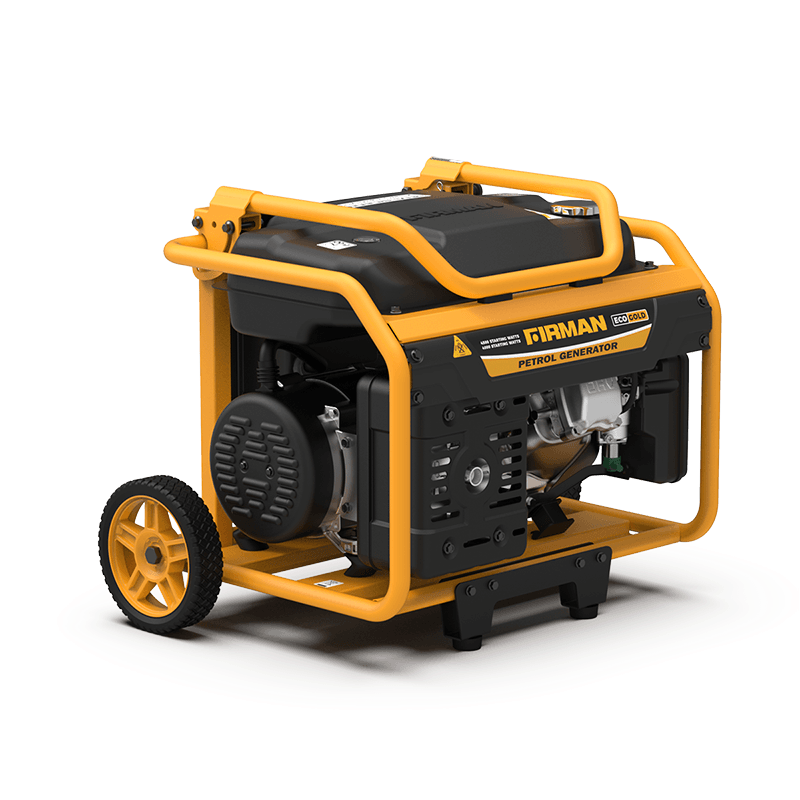
FIRMAN’s EG20 petrol generator illustrates why specification-level comparison matters. Its official product page lists 4.5 kW starting watts and 4.0 kW running watts, with a single-phase output and power factor of 1. These figures provide a clearer basis for evaluating whether the model fits a particular commercial application.
Examine Alternator Design and Construction
The alternator is another area where power equipment manufacturers can differ substantially. Buyers should examine alternator construction, excitation method, winding material, pole configuration, and other relevant specifications rather than relying solely on overall generator wattage.
The FIRMAN EG20 uses a brush, self-exciting, synchronous, 2-pole alternator with 100% copper enamelled wire. Its listed alternator specification is φ165 × 130. The product page also highlights a heavy-duty alternator crafted from silicon steel.
For professional purchasing, these details are useful because they provide a more meaningful technical comparison between generator models. They also help buyers evaluate whether the electrical design corresponds with the intended operating requirements and expected workload.
Evaluate Runtime, Fuel Capacity, and Operating Costs
Runtime should be considered alongside fuel capacity, load conditions, and the generator’s intended duty cycle. A longer runtime can reduce refueling interruptions, which may be valuable on construction sites, temporary facilities, outdoor operations, and emergency applications.
The FIRMAN EG20 is officially specified with a 15-liter fuel tank and an approximate runtime of 8.5 hours on one tankful at 50% load. Its listed oil capacity is 1 liter. Buyers should pay attention to the load condition attached to a runtime figure because operating at a different load can change actual fuel consumption and runtime.
This is also an area where procurement teams should verify manufacturer specifications carefully. Marketing materials can contain generalized feature descriptions, while the detailed product specification provides the figures needed for an accurate purchasing comparison.
Consider Noise, Mobility, and Site Requirements
Commercial equipment is often moved between work areas, so portability and physical design can influence productivity. Buyers should review gross weight, wheel design, handle configuration, frame construction, and packing dimensions when equipment will be transported frequently.
The EG20 weighs 63 kg and has a packing size of 620 × 490 × 525 mm. It features a fold-down handle with an easy-release pin, wheels, and a semi-silent design with a muffler and noise eliminator. The noise level is 69 dB at 7 meters.
These features can be particularly relevant for contractors and other professional users who need equipment that can be moved around a jobsite while providing the required output.
Review Safety and After-Sales Support
Safety should remain part of the supplier evaluation, not an afterthought. Portable petrol generators produce carbon monoxide, and the U.S. Consumer Product Safety Commission advises that they must never be operated inside homes, garages, basements, sheds, or other enclosed areas.
Buyers should also review manuals, maintenance guidance, spare-parts availability, warranty arrangements, and technical support before placing a large order. A lower initial price may not represent better value if servicing becomes difficult or replacement components are difficult to obtain.
Make the Comparison Based on Total Value
The strongest comparison among power equipment manufacturers considers the complete operating picture: output, alternator design, runtime, fuel requirements, noise, mobility, safety, service support, and portfolio flexibility. Price remains relevant, but it should be assessed alongside expected operating conditions and long-term usability.
For businesses evaluating electric generator manufacturers, FIRMAN provides a broad product range and detailed model specifications that can support a more structured procurement process. Its power machinery portfolio includes multiple generator series and fuel types, allowing buyers to compare solutions according to application and capacity requirements.
Choosing a Manufacturer With Practical Business Value
A successful purchasing decision starts with defining the application and then comparing manufacturers against measurable criteria. Instead of focusing on one headline specification, business buyers should assess the complete equipment package and the supplier’s ability to support ongoing operational needs,
or organizations sourcing generators or other power equipment, factors such as portfolio breadth, detailed specifications, engineering features, and support services should all be included in the evaluation. A systematic comparison can help businesses select equipment that delivers dependable performance while aligning with project requirements and long-term purchasing objectives.
