
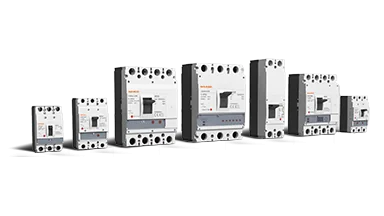
Selecting suitable electrical control products is an important part of designing a safe and reliable power distribution system. Among the most frequently compared options are the miniature circuit breaker and mould case circuit breaker. Although both provide overcurrent protection, they are designed for different circuit capacities, installation environments, and protection requirements.
Understanding the practical differences between MCB and MCCB can help engineers, contractors, distributors, and system designers select equipment more efficiently while avoiding unnecessary oversizing or inadequate protection.
Understanding the Role of MCB in Electrical Protection
A miniature circuit breaker, commonly known as an MCB, is generally used for terminal circuits with relatively modest current requirements. Its compact modular construction makes it suitable for applications such as lighting circuits, socket circuits, commercial buildings, residential distribution boards, and certain general industrial applications.
When an overload or short circuit occurs, an MCB automatically interrupts the circuit to reduce the risk of equipment damage and electrical hazards. Its compact dimensions also make it practical where distribution board space is limited.
However, selecting an MCB should not be based on physical size alone. Rated current, breaking capacity, voltage, number of poles, trip characteristics, and the characteristics of the connected load should all be considered. The breaker must coordinate with the cable and downstream equipment so that protection operates appropriately under abnormal conditions.
When a Mould Case Circuit Breaker Is More Appropriate
A mould case circuit breaker, or MCCB, is intended for circuits with higher current requirements and more demanding distribution conditions. Compared with an MCB, an MCCB generally provides a broader range of ratings and greater flexibility for larger commercial and industrial distribution systems.
MCCBs can be applied to main distribution circuits, feeders, industrial equipment, and larger building power systems. Depending on the model, protection functions and adjustment options can also provide greater control over overload and short-circuit protection.
For project planning, MCCB ratings should therefore be evaluated against the expected operating current, prospective fault current, cable capacity, and coordination requirements. Choosing a breaker with a higher rating than necessary is not automatically safer. Protection must be matched to the actual system so that the breaker can respond effectively when abnormal current occurs.
MCCB Ratings and MCCB Sizes: What Should Be Evaluated?
MCCB ratings and MCCB sizes are two practical factors that often influence equipment selection, but they should be evaluated together with electrical requirements.
The rated current indicates the level of current the breaker is designed to carry under specified conditions. Meanwhile, MCCB sizes can vary according to current rating, frame size, construction, and functional configuration. A larger physical frame does not necessarily mean that it is the correct choice for every application.
Engineers should first determine the system’s normal operating current and expected future load. The required short-circuit breaking capacity should then be checked against the available fault level at the installation point. Voltage, frequency, number of poles, ambient conditions, installation method, and coordination with upstream and downstream protection should also be considered.
This project-level approach helps avoid two common problems: selecting equipment that cannot provide sufficient protection and selecting oversized equipment that increases cost and installation requirements without delivering a practical benefit.
MCB or MCCB? Consider the Entire Distribution System
The choice between MCB and MCCB should reflect where the device is installed within the distribution architecture. MCBs are commonly positioned closer to terminal loads, while MCCBs are more suitable for feeders and higher-capacity distribution sections.
A typical system may use both rather than treating them as competing products. An MCCB can protect a larger feeder or distribution section, while MCBs can provide protection for individual downstream circuits. Proper coordination between these devices helps isolate faults closer to their source and maintain continuity for unaffected circuits.
The selection should also consider maintenance requirements and available installation space. MCBs offer a compact modular format, while MCCBs provide a more substantial construction for higher-capacity applications. For projects that require monitoring or remote functions, intelligent breaker options may also be considered.
Choosing Electrical Control Products for Long-Term Project Requirements
Circuit protection is only one part of a complete electrical control system. Depending on the application, a project may also require residual current protection, surge protection, contactors, thermal relays, distribution boxes, and other industrial control components.
MAXGE provides a broad range of electrical control products covering MCB, MCCB, ACB, RCD and RCBO, smart breakers, distribution boxes, and industrial devices. Its product range also includes accessories designed to extend the functions of selected protection and control equipment.
For project teams, evaluating products as part of an integrated system can make specification and procurement more consistent. Product documentation, applicable standards, technical parameters, installation requirements, and compatibility should be reviewed before final selection.
Make the Selection Based on the Application
There is no universal answer to whether an MCB or MCCB is better. The appropriate choice depends on circuit current, prospective fault level, load characteristics, distribution position, available installation space, protection coordination, and project requirements.
For smaller terminal circuits, an MCB can provide a compact and practical protection option. For larger feeders and distribution systems, an MCCB can accommodate higher current requirements and provide additional protection and adjustment options. Evaluating these factors together helps align the selected device with the electrical conditions rather than relying on rated current or physical dimensions alone.
MAXGE offers a broad low-voltage electrical product range covering circuit protection and control for different distribution and application requirements. Its solutions also extend to PV, renewable energy, energy storage, and EV charging systems. Manufacturing at its Deqing and Wuhu bases, supported by more than 90% automation, works alongside R&D resources, patented technologies, software copyrights, CNAS-related laboratory capabilities, and international certifications.
Through the MAXGE, EMA, and GEBLER brand portfolio, the company serves markets in more than 60 countries with support from over 80 distribution partners. For detailed specifications, product selection, or project-related application questions, you can contact MAXGE through its official website. Making the selection at the design stage can help establish a protection system that is appropriately rated and aligned with the operating requirements of the installation.
