
Every battery energy storage system has to cross an electrical boundary. Batteries store energy as DC, while most grids and many facility loads operate on AC, so a bidirectional converter must manage energy moving in both directions.
The efficiency and controllability of that conversion depend partly on the semiconductor switches inside the equipment. Conventional silicon IGBT technology has served this role for years, but silicon carbide devices are changing the design options available to a power conversion system.
A SiC energy storage inverter can reduce key switching and conduction losses in suitable operating conditions, opening a path toward higher efficiency, denser hardware, and faster power-stage operation without changing the fundamental requirement for safe, coordinated bidirectional conversion.
From Silicon Switching Limits to SiC Characteristics
An IGBT and a SiC device do not lose energy in exactly the same way during conduction and switching. In a power conversion system, semiconductor losses accumulate every time current passes through a device and every time the device changes state.
Silicon carbide devices can switch faster and with lower switching loss than conventional silicon IGBTs in many high-performance converter designs. SiC-based converter hardware can therefore operate at switching conditions that would impose a larger loss penalty on an IGBT-based design.
The engineering result is not simply a higher efficiency figure; lower loss changes the heat that must be removed and can alter the size of magnetic and cooling components surrounding the semiconductor stage.
The difference becomes more visible as switching frequency rises. Higher-frequency operation can reduce the required size of some inductive and filtering components, but only if the additional switching loss remains manageable.
Conventional IGBT designs often face a stronger efficiency penalty as frequency increases, while SiC gives designers more room to trade switching frequency against component size and control requirements. The final design still depends on voltage, current, topology, and thermal limits, yet the available trade space is wider.
Efficiency Changes More Than the Energy Bill
Conversion loss appears as heat, so every efficiency improvement affects the thermal design of a power conversion system. Lower heat generation can reduce stress on cooling hardware and create more freedom in cabinet and component layout.
SiC-based storage hardware may also use higher switching frequencies to reduce the size of certain passive components, contributing to higher power density where the overall topology supports it. These characteristics are relevant to storage projects that need substantial power in a restricted footprint.
The advantage still depends on the full converter design, because semiconductor technology, control strategy, magnetics, filters, protection, and cooling work as one electrical system rather than as independent specifications. Part-load operation is also relevant because storage equipment does not remain at rated output throughout the day.
Charging power changes with battery state and site conditions, while discharge power follows dispatch commands and load demand. Loss behavior across that operating range influences annual energy throughput and heat generation more than a single peak-efficiency point can show. Evaluating semiconductor technology therefore requires attention to the duty cycle that the storage converter will actually experience.
Fast Power Stages Meet Grid-Forming Control
Energy storage increasingly serves weak-grid, off-grid, and hybrid microgrid applications, where the converter may need to do more than follow an existing grid reference. A power conversion system can be required to respond to sudden load changes, move between grid-following and grid-forming operation, and coordinate with diesel generation or renewable sources.
Grid-forming control can combine virtual synchronous generator behavior, droop functions, and transitions between grid-following and grid-forming operation so the converter responds to more than an energy-dispatch command. A SiC energy storage inverter used in this role becomes part of a broader control strategy rather than only an efficiency component.
Device Technology Becomes a Microgrid Capability
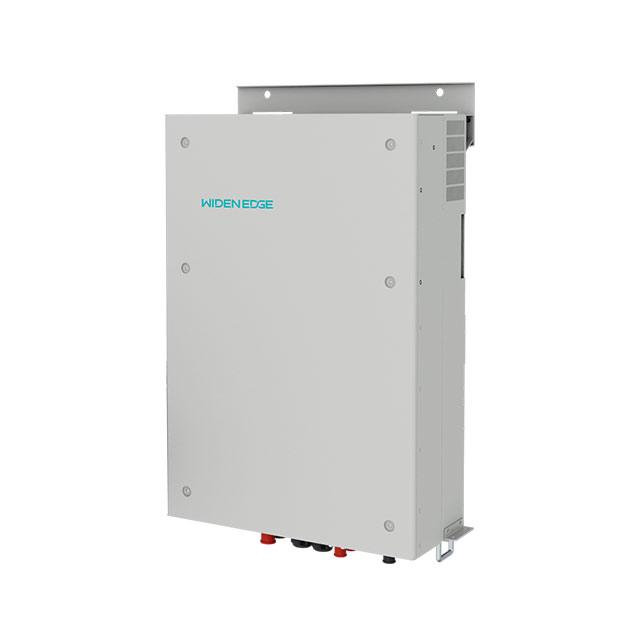
WidenEdge’s 100/150kW MGC MK2 illustrates how semiconductor and control choices can converge inside a power conversion system. In off-grid mode it supports 100% unbalanced loads, while its transformerless architecture provides independent neutral-line current regulation during on-grid operation. Its control package is designed for high-overload operation, includes a synchronization interface, and adjusts automatically as local demand changes, including sudden load steps.
SiC-based storage conversion in this context is not defined solely by lower switching loss. WidenEdge also incorporates automatic diesel-generator control and self-learning of key generator parameters, linking conversion hardware with the operating demands of solar-storage-diesel and other microgrid arrangements.
SiC Expands the Converter Design Space
The change brought by SiC is therefore best understood as a redesign opportunity rather than a simple component substitution. Lower switching and conduction losses can influence efficiency, thermal load, switching frequency, and power density, while advanced control determines how those electrical advantages are used in real storage systems.
A modern power conversion system must still be selected around battery characteristics, load behavior, grid strength, operating mode, and coordination requirements. The MGC MK2 shows how WidenEdge applies the wider SiC design space to a storage converter that must manage both energy transfer and microgrid operating duties.
In a SiC energy storage inverter, semiconductor performance becomes most meaningful when it expands what the complete storage converter can do under real operating conditions.
SEO Title: Why SiC Is Changing Power Conversion Systems for Energy Storage | WidenEdge
Meta Description: Read our latest insights on Why SiC Is Changing Power Conversion Systems for Energy Storage. Explore switching losses, efficiency, and grid-forming control.
