
Opening a water attraction involves far more than selecting attractive rides and preparing a pool area. Operators must consider guest demand, site conditions, safety, staffing, maintenance, water quality, and long-term operating costs before welcoming the first visitors. A structured decision process helps reduce costly changes later. For investors and project managers, these eight questions provide a practical framework for evaluating a new attraction and working effectively with a water park manufacturer.
- Who Is the Attraction Designed to Serve?
The first question should focus on the target guest. Families, teenagers, thrill-seekers, resort guests, and local visitors may have very different expectations. An attraction portfolio should therefore balance excitement, accessibility, capacity, and visual appeal rather than simply selecting the most dramatic rides available.
Operators should examine local demographics, tourism patterns, expected visitor volumes, and competing facilities. This information can guide decisions about attraction types and help determine whether a major water slide, family play area, or combination of experiences will generate the strongest commercial value.
- Does the Site Support the Planned Attractions?
A water attraction must work within the physical characteristics of its site. Available land, elevation, circulation routes, structural requirements, equipment rooms, drainage, utilities, and emergency access all influence the final layout.
Large slides require careful spatial planning because their towers, runout areas, stairs, and circulation zones must work together. A professional water park manufacturer can help operators evaluate attraction dimensions and integrate equipment into the overall master plan before construction begins.
- What Safety Requirements Must Be Met?
Safety should be treated as a design and operating requirement from the beginning, not as a final inspection item. IAAPA emphasizes daily ride inspections, operator training, and guest safety procedures as important elements of water park operations.
Operators should ask which local codes and standards apply to the project and what documentation will be required. The CDC’s Model Aquatic Health Code also provides guidance covering aquatic facility design, lifeguard training, water quality, and operation for public aquatic venues.
- How Will Water Quality and Facility Systems Be Managed?
Attraction performance depends on more than the slide itself. Operators need suitable filtration, circulation, disinfection, drainage, and monitoring systems. These systems should be considered alongside the attraction layout so that technical requirements do not become an expensive afterthought.
The CDC recommends pre-opening inspections of aquatic venues and emphasizes checking disinfection, circulation systems, filters, and related equipment. A practical water attraction opening checklist should therefore include both ride equipment and supporting water systems.
- What Capacity Can the Attraction Deliver?
Capacity affects revenue, queues, staffing, and guest satisfaction. Operators should ask how many people can use an attraction simultaneously, how quickly riders can be dispatched, and whether the attraction can handle projected peak demand.
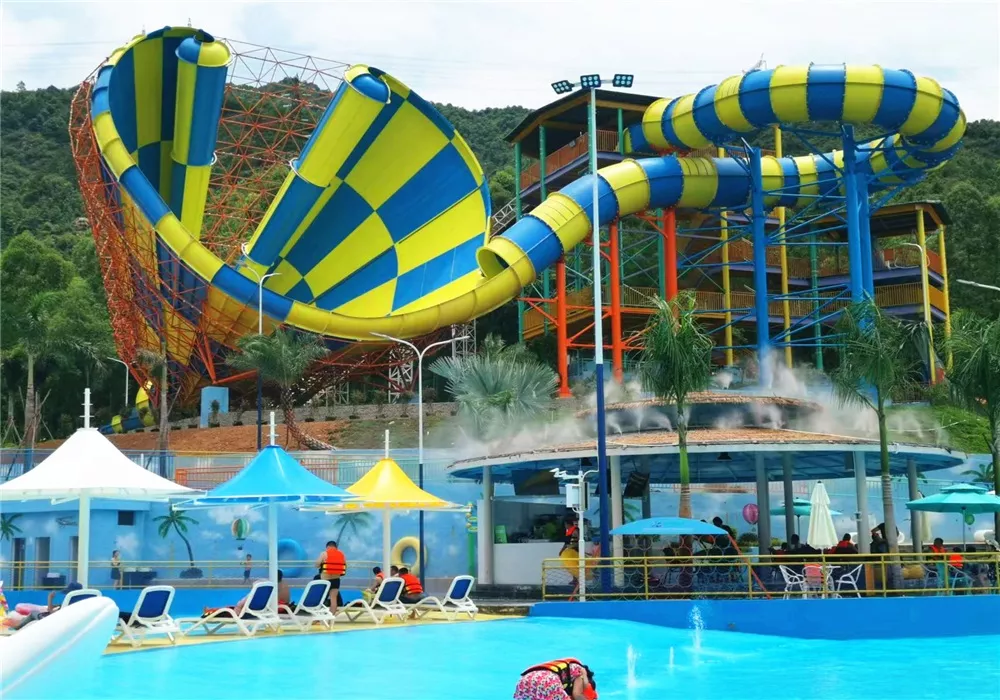
Jinchao’s Tornado Slide provides an example of capacity-oriented design. Its official specifications list a starting height of 12–18 m and capacity for up to four riders. The product description further specifies a 12–15 m platform height, an 18 m Giant Funnel diameter, and a 20 m Abyss Slide diameter.
- Will the Attraction Create a Strong Visual Identity?
A commercially successful water attraction needs to be memorable before guests even ride it. Towers, funnels, colors, themes, and overall silhouettes can become important visual elements in a park’s identity and marketing.
The Tornado Slide is particularly relevant for projects seeking a prominent centerpiece. Jinchao describes it as an iconic attraction designed to capture attention from a distance, while its large funnel creates a strong visual presence. It can also share a platform with other large slides, which may provide additional flexibility when developing a larger attraction zone.
- What Will Daily Operations Require?
Operators should calculate staffing, inspections, cleaning, maintenance, spare parts, training, and emergency procedures before selecting equipment. A ride that looks impressive but requires an unsuitable operating model can create difficulties after opening.
IAAPA identifies inspection, maintenance, employee training, equipment, and guest safety as core areas of water park operations. Effective water park operations planning should therefore connect attraction selection with the actual capabilities of the operating team.
- Can the Manufacturer Support the Project Beyond Delivery?
The final question should concern the relationship with the supplier. Operators should understand whether the manufacturer provides design assistance, engineering coordination, installation guidance, technical documentation, and after-sales support.
Jinchao positions itself as a water park manufacturer providing integrated design, equipment manufacturing, construction support, and global service. Its website states that the company has 15 years of experience, more than 300 global water park construction cases, and a manufacturing facility of approximately 36,000 square meters.
For buyers developing a commercial project, choosing a supplier capable of supporting the attraction through multiple project stages can simplify coordination and reduce communication gaps.
Turning Questions Into a Better Opening Strategy
A successful attraction begins with decisions made before construction starts. By examining target guests, site conditions, safety, water systems, capacity, visual identity, operations, and supplier support, operators can build a stronger foundation for long-term performance.
The role of a water park manufacturer is not limited to producing equipment. For a project such as Jinchao’s Tornado Slide, technical specifications, attraction positioning, capacity, and integration with the wider park should all be considered together. An aquatic facility startup guide can help project teams organize these decisions, but experienced suppliers can provide the technical input needed to turn the plan into a workable attraction.
