
There is a huge change happening in the global dental laboratory market. The Asia-Pacific region is expected to grow at a compound annual growth rate of 6.6% through 2026. This growth is based on a key point where changes in demographics and technology have come together. By 2050, the number of older people in Asia is expected to double. This means that the need for complex prosthetics, from multi-unit bridges to full-arch implant restorations, has never been higher. At the same time, the rise of “digital native” dental technicians is speeding up the move from manual waxing, which takes a lot of time and effort, to automated, high-precision subtractive and additive manufacturing.
The evolution of restorative materials is driving the demand from a scientific point of view. The newest types of multilayer zirconia and hybrid ceramics are very strong (over 1200 MPa) and have a unique mix of translucency and fracture resistance. But these materials need very specific milling parameters and precise sintering protocols that older lab equipment just can’t give. In a modern lab, the choice to upgrade is based on the need to handle these high-performance materials correctly while also meeting the quick turnaround times that are needed in today’s clinical settings.
Improving Quality by Working with the Right People
As labs move towards full digital integration, it is more important than ever to have a reliable ecosystem for buying and learning. MDfA (Messe Düsseldorf for Asia) meets this need by putting together high-level business platforms that link regional lab owners with global engineering leaders. In a market where buying a 5-axis mill or a high-resolution 3D printer costs a lot of money, MDfA gives you the information and technical depth you need to make smart investment choices.
The organisation makes sure that the “digital thread”—the smooth flow of data from the dental chair to the lab bench—is a main focus of its exhibitions through its large MEDICAlliance network. MDfA helps labs avoid the problems that come with closed-system proprietary technology by focussing on how well software and hardware work together. This open-architecture approach lets labs add capacity as their client base grows, which is important for keeping up with the high quality standards expected in a modern dental service.
The Future Laboratory: FAMDENT Hyderabad
The HITEX Exhibition Centre in Hyderabad will host the FAMDENT Exhibition on February 7–8, 2026. This is a key event for this industrial evolution. This show, which has more than 120 exhibitors, is made just for South India’s growing dental economy. This area is quickly becoming a hub for high-value restorative manufacturing. The event gives lab professionals more than just a look at new hardware; it gives them a full look at the automated process chains that make up the “Lab 4.0” era.
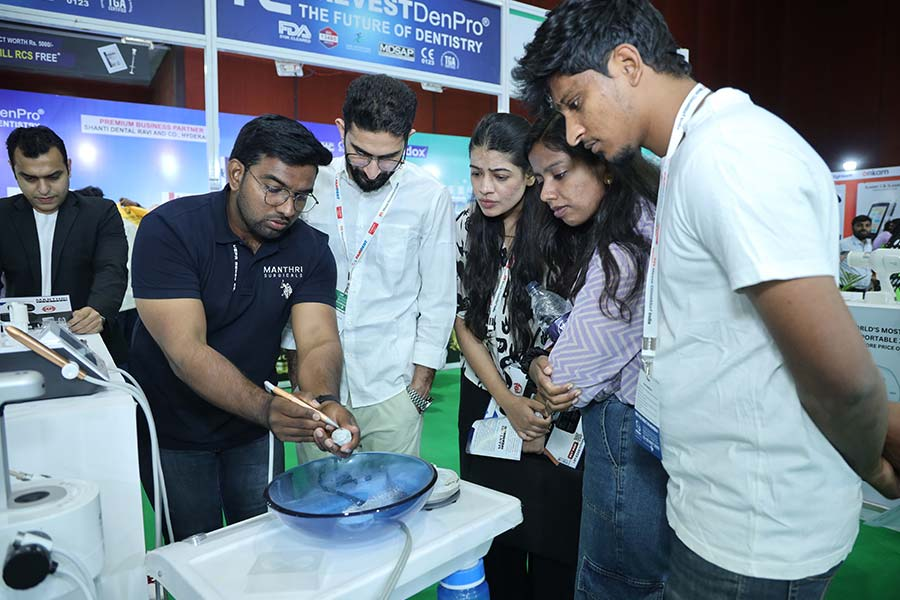
People who come can see live demonstrations of new dental equipment, such as wet-milling units made for glass ceramics and lithium disilicate. These machines are very important for labs that support chairside-integrated clinics, where patients expect to get a permanent restoration in less than 24 hours. FAMDENT 2026 also talks about how 3D printing can be used to make surgical guides and temporary restorations with 8K precision. This lets labs offer more services than just crowns and bridges.
The Human Factor and Technical Accuracy
The HITEX Exhibition Center’s hardware shows a shift towards “smart” automation. Modern milling machines have automatic tool changers and AI-powered sensors that keep an eye on how much wear is happening to the tools in real time. This stops micro-fractures from forming in fragile zirconia frameworks. For high-volume labs, where even a 1% remake rate can have a big effect on profits, this level of technical oversight is very important. Also, the standard now is advanced dental scanners that are accurate to 5 microns. This makes sure that the digital impressions sent from the clinic are turned into prosthetics that fit perfectly.
This big step forward in technology directly improves the quality of the final dental service. When a lab uses very precise tools, they don’t need to make adjustments at the chairside as often, which leads to better clinical outcomes and happier patients. These tools mark a change for the technician from making things by hand to making things with computers. With these tools, they can change the shape of teeth in ways that were not possible before.
In conclusion
The need for high-tech dental lab equipment shows that the industry is growing up and values speed, accuracy, and high-quality materials. Laboratory owners can stay competitive by using the global platforms offered by MDfA and checking out the new products at the FAMDENT Exhibition Hyderabad 2026. Digital technology is the future of dental manufacturing, and those who buy the right tools now will be the leaders in the field of restorative dentistry in the future.
